
Module 5 · for hyperacusis
Beginning to meet sound
Everything so far has been preparation for this. This module begins the gradual work of letting sound back in, starting at the very lowest rung of your ladder, on your terms, with every skill you’ve built standing alongside you. Gentle is not a compromise here. Gentle is the method.
First, how did the week go?
A couple of minutes looking back before the new material. Start with what worked; it’s the easiest part to overlook and the most worth building on.
Your weekly check-in
Complete your check-in in Practice Better, where your responses are saved and reviewed by your coach.
Open Hyperacusis Weekly Check-In (opens in a new tab)Opens Practice Better in a new tab; return to this page after submitting.
Already completed it? Continue to this week’s material below.
Why meeting sound turns the gain down
Back in Module 1 you saw the cycle: avoiding sound makes the system compensate by turning its gain up, and tolerance narrows. The way out is the same loop run in reverse: steady, manageable contact with ordinary sound is the signal that lets the system turn its gain back down. The goal is neither complete silence nor pushing through symptoms. It is finding the amount and type of sound your system can tolerate without provoking pain or a sustained worsening. Not by pushing through, and never by enduring what hurts. By spending unhurried time with sounds that are only mildly uncomfortable, until your nervous system re-learns what it once knew: this sound is safe.
Something reliable happens when you stay with a mildly uncomfortable sound instead of leaving: the distress rises, crests, and then, without you doing anything, begins to come down on its own. Your body cannot hold peak alarm about a safe thing forever; settling is what nervous systems do when nothing bad happens. Every time you stay long enough to feel that settling, you hand the system a piece of evidence no argument can match. That, repeated, is the whole method.
This mechanism (gain turning back down with steady, safe contact) is well established in face-to-face hyperacusis treatment; it hasn’t been separately demonstrated in a self-guided digital format like this one, but it’s a reasonable, evidence-informed extrapolation, not a downgrade.
Not every session will show a clean settle, and that’s fine; some days the number barely moves. The learning isn’t really in the number. It’s in staying long enough to find out that the thing you feared didn’t happen. That still counts, even on the sessions where the distress stays stubbornly put.
You’re not toughening your ears. You’re showing your nervous system, one calm visit at a time, that it can stand down.
How the work is done, and how it isn’t
Graded exposure has a shape, and the shape is what makes it both safe and effective. Four rules carry most of it:
- Start at the bottom rung. This week is Tier 1 only: the sounds you placed around 20–30 on your SUDS ladder. Noticeably uncomfortable, clearly bearable. If in the moment a sound turns out harder than that, it isn’t this week’s sound.
- Stay long enough to test it. Leaving right at the peak means you don’t get to find out what happens next; staying a little longer usually does. Give a session ten, fifteen, twenty minutes: long enough to feel the distress come down from its peak, even partway.
- Real sound, in the room. Everyday sounds where they live: the kitchen, the street, a café at a quiet hour. If you use a recording, it plays on open-ear speakers, never headphones or earbuds.
- Bring your skills, not white knuckles. Slow, low breathing before and during; a loose jaw and dropped shoulders; a thought record afterward if a hot thought showed up. The skills are there so you can stay settled, not just stay.
And one distinction worth underlining: discomfort is expected and workable; it’s the material the learning is made from. Pain is not. Pain is a stop signal, this week and every week.
Before your first session, the same distinction from intake, restated because it matters here specifically: a familiar rise in discomfort during exposure is the pattern this work addresses. Sudden or one-sided hearing loss, new one-sided or non-stop ringing, ear fullness with an actual change in your hearing, or dizziness are not that pattern: stop the exercise and don’t wait for your next check-in; sudden hearing loss especially is time-sensitive, so contact your clinician or seek prompt medical care.
And one more honest thing, said before your first session rather than after: some people whose sensitivity comes with pain report that exposure made things worse rather than better. That pattern is recognized, even though it hasn’t been studied in a trial, and it isn’t a sign of doing the work wrong. If pain stalls or creeps up across sessions instead of easing, stopping and using the pause-and-contact route below is the protocol, not a failure of it. Kodama has no evidence to recommend prolonged silence or protection as an alternative path either, so the honest answer is the off-ramp, used early, and a conversation with your own provider.
The earplug trap
There’s a habit that feels like the responsible choice and works against you without you noticing: wearing earplugs or ear defenders in ordinary sound: the supermarket, the office, conversation at home. Protection in everyday sound is avoidance the system can’t tell apart from any other kind: it starves the ears of normal input, the gain climbs further, and the world comes back louder each time the plugs come out.
So the guideline is: save protection for genuinely loud events (power tools, a concert, machinery, a lawnmower) where anyone would sensibly wear it, and let ordinary sound reach you plain elsewhere: conversation, a supermarket, an office, traffic on the pavement. If you’ve been wearing protection most of the day, don’t drop it all at once. Use the program’s built-in grading rules to choose the smallest manageable reduction, and stay there until it becomes ordinary.
How a session goes
A session is simple and unhurried. Here’s the shape of one, step by step, worth walking through once now, before your first.
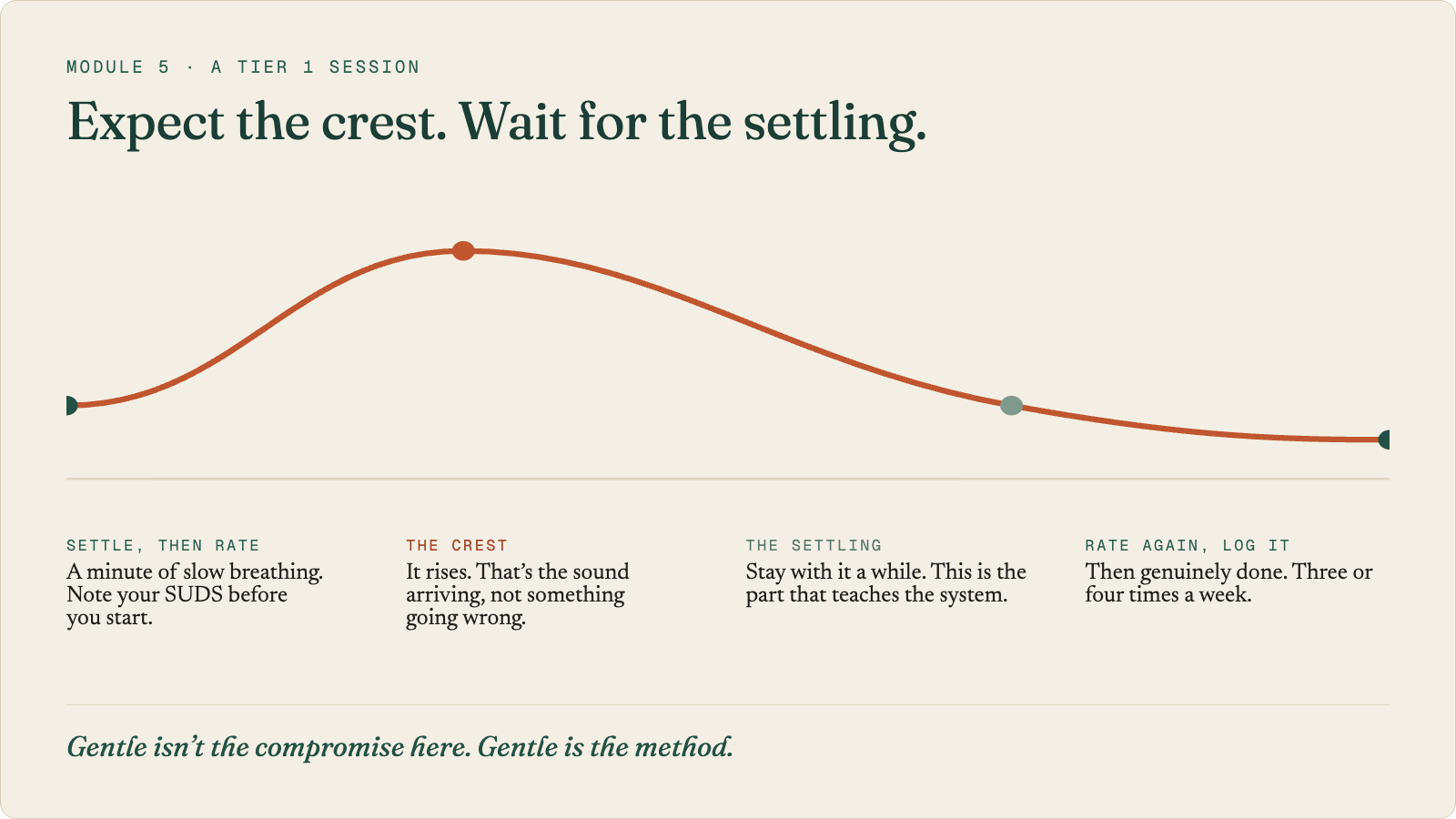
A Tier 1 session, start to finish
Self-paced · move at your own speedOne session like this, three or four times across the week, is the aim. Same sound each time or a different Tier 1 sound; repetition of the settling is what counts, not variety.
Expect wobbles, and know the protocol
Let’s pre-arm you with something everyone doing this work needs to hear: progress here is jagged, not smooth. You will have days where a sound that was fine on Tuesday lands hard on Friday, after bad sleep, a stressful stretch, a cold. That’s not the program failing and it’s not you backsliding; it’s the normal texture of a nervous system re-learning, and the people who do best are the ones who expected the wobbles and kept going gently through them.
At the same time, gentle work deserves clear guardrails. Here’s exactly what to do, depending on what you notice:
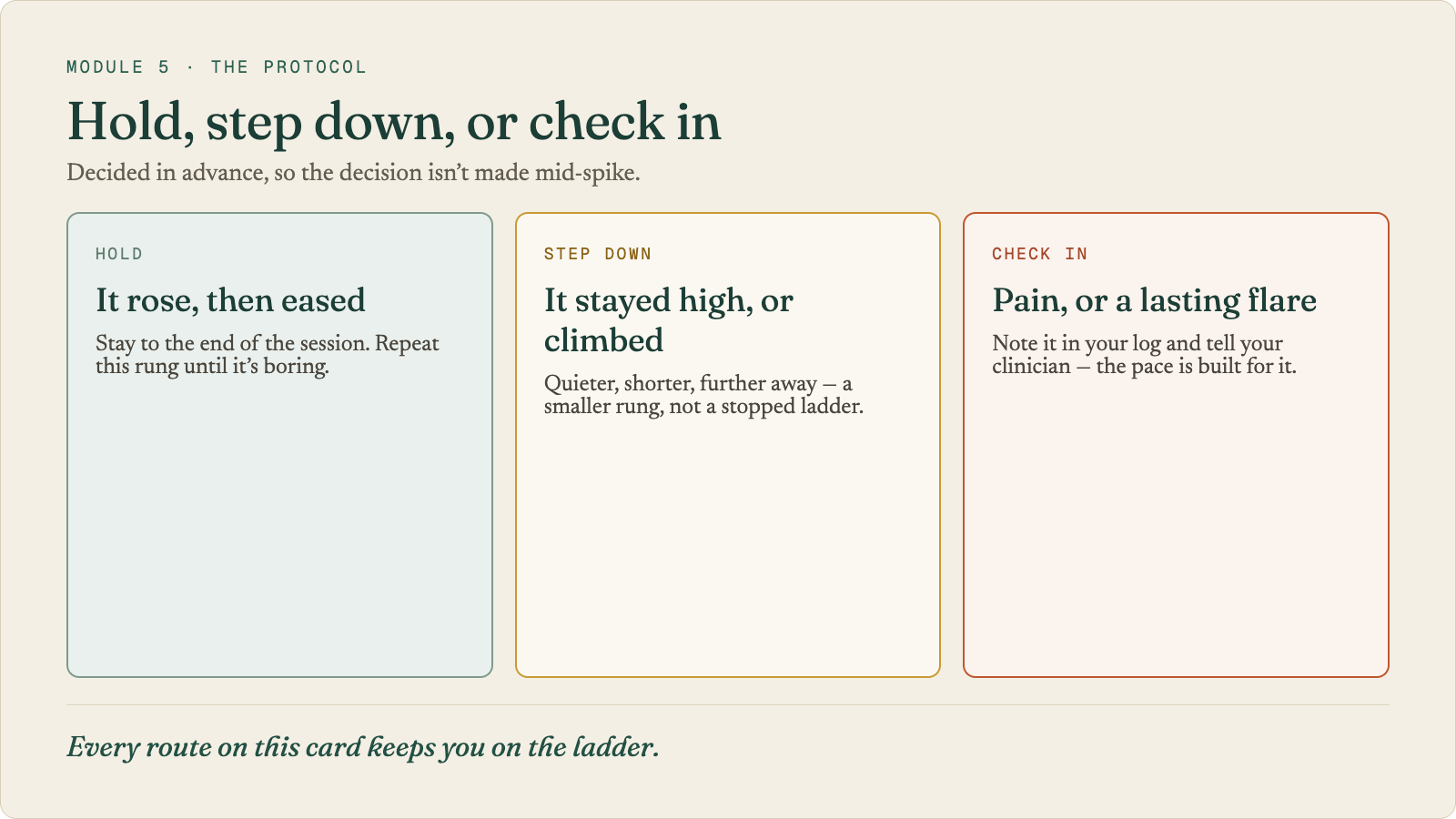
If pain is part of your picture, use the Pain Pathway’s built-in pacing: slower steps, longer holds at each rung, and no pushing through pain. Sharp or stabbing pain means stop; new, worsening, or lingering pain means pause exposure, note it in your check-in, and contact your own outside provider. Going slower is not falling behind; for this pathway, it is the plan.
Rehearsing at home first
Rule 3 above says real sound, in the room, is what this works on. Some days, or some sounds, that isn’t available to you. For those days, a small library of Tier 1 sounds is here to rehearse with, on the same open-ear-speakers rule as any recording. Use it for planning, not as your standing substitute for the real thing.
Practice with the sound library
Optional · Tier 1 · open-ear speakers, not headphonesNo practice sounds have been added to the library yet; use a real-world sound in the session companion below instead.
Browse the full library: everything that’s stocked, grouped by where you’d meet it, each with a suggested tier.
Your session log
Log each session while it’s fresh. The before → peak → after numbers are the point: across a few honest sessions, you’ll watch the settling happen on paper. Use the saved log below so you and your coach can see the pattern at the next check-in. If you’d like company through a session, the unsaved companion underneath it walks you through the steps (settle, before, timer, peak and after) and gives you a summary to paste into the log.
Your exposure practice log
Log each session in Practice Better while it's fresh — before, peak, and after — so you and your coach can see the settling pattern at your check-in.
Open the Exposure Practice Log (opens in a new tab)Opens Practice Better in a new tab; return to this page after submitting.
Or run the session here first (unsaved)
Session companion
Private · stays on this screenThe same steps as the walkthrough, with a timer and three SUDS numbers. When you’re done, copy the summary and paste it into the log above. Nothing here is kept once you leave the page.
A minute of slow, low breathing before the sound starts. Let the circle lead, or just follow the words.
Slow and low, not big
Start the timer, start the sound (or step into it), and do the ordinary part. The timer is company, not a target: ten to twenty minutes is plenty, and you close it whenever you close it.
Paste it into the log above while it’s fresh. A session where the numbers didn’t settle is still worth logging; the honest record is what lets you apply the hold, step-down, or pause rule.
Remember why you’re doing this
You’re not practicing the dishwasher because the dishwasher matters.
You’re practicing because each settled session brings you one step closer to the sounds that do: a full table at dinner, everyone talking at once. Music, played the way it’s meant to be played. A restaurant with a friend, a movie in an actual theater, the everyday racket of the people you love. Those are the upper rungs of the ladder, and the only reason the bottom rungs are worth standing on.
So name yours. On the hard days, and there will be a few, the dishwasher won’t feel worth it. These will.
Save your next steps
Enter your one to three goals in Practice Better, where they are saved and the next weekly check-in can refer back to them.
Open Hyperacusis: My Next Steps (opens in a new tab)Opens Practice Better in a new tab; return to this page after submitting.
Your skills
The fifth is the one the first four were building toward.
Skills you’ve learned
5 of a growing setModule 6 climbs to the next rung, and starts bringing the sounds that matter most back into your life.
This week’s practice
Three or four gentle sessions, well logged, beats seven rushed ones. Everything else continues underneath.
Module 5 practice
This week’s homework is set up as a task in Practice Better; you’ll get a reminder and can check it off there.
- Do three or four Tier 1 sessions across the week, and log each
- If using earplugs in ordinary sound, begin easing them back
- Keep the foundations going: enrichment, body skills, thought records
- Always note pain, if any, in your Exposure Practice Log entries
That’s Module 5. You’ve started the real work: not enduring sound, but showing your nervous system, visit by settled visit, that it can stand down. Every session where you felt the crest and the coming-down is evidence banked.
Stay at this rung until it’s genuinely boring; that’s the built-in signal that you’re ready to climb. You make that choice using the module’s rules, and your coach can reflect the same guidance back to you. Jagged weeks included, you’re doing it right.
You’re also roughly at the halfway point of the program. Around now, a fuller set of questions may appear alongside the usual weekly check-in, a way of taking stock of how things have shifted overall, not just week to week.
Save your next steps
Enter your one to three goals in Practice Better, where they are saved and the next weekly check-in can refer back to them.
Open Hyperacusis: My Next Steps (opens in a new tab)Opens Practice Better in a new tab; return to this page after submitting.
Your next module unlocks automatically in Practice Better; you’ll get an email when it’s ready.
Back to all modules