
Module 2 · for hyperacusis
The CBT model for sound sensitivity
The same sound can barely register one day and feel unbearable the next. That difference isn’t random; it runs through a short chain of thought, feeling, and response, and once you can see the chain, you can find the one place in it where you have real leverage.
First, how did the week go?
Before any new material, a couple of minutes looking back. This isn’t a test, and there’s no right answer; it’s how you and your coach stay oriented to what’s actually happening for you.
Your weekly check-in
Complete your check-in in Practice Better, where your responses are saved and reviewed by your coach.
Open Hyperacusis Weekly Check-In (opens in a new tab)Opens Practice Better in a new tab; return to this page after submitting.
Already completed it? Continue to this week’s material below.
The chain from sound to distress
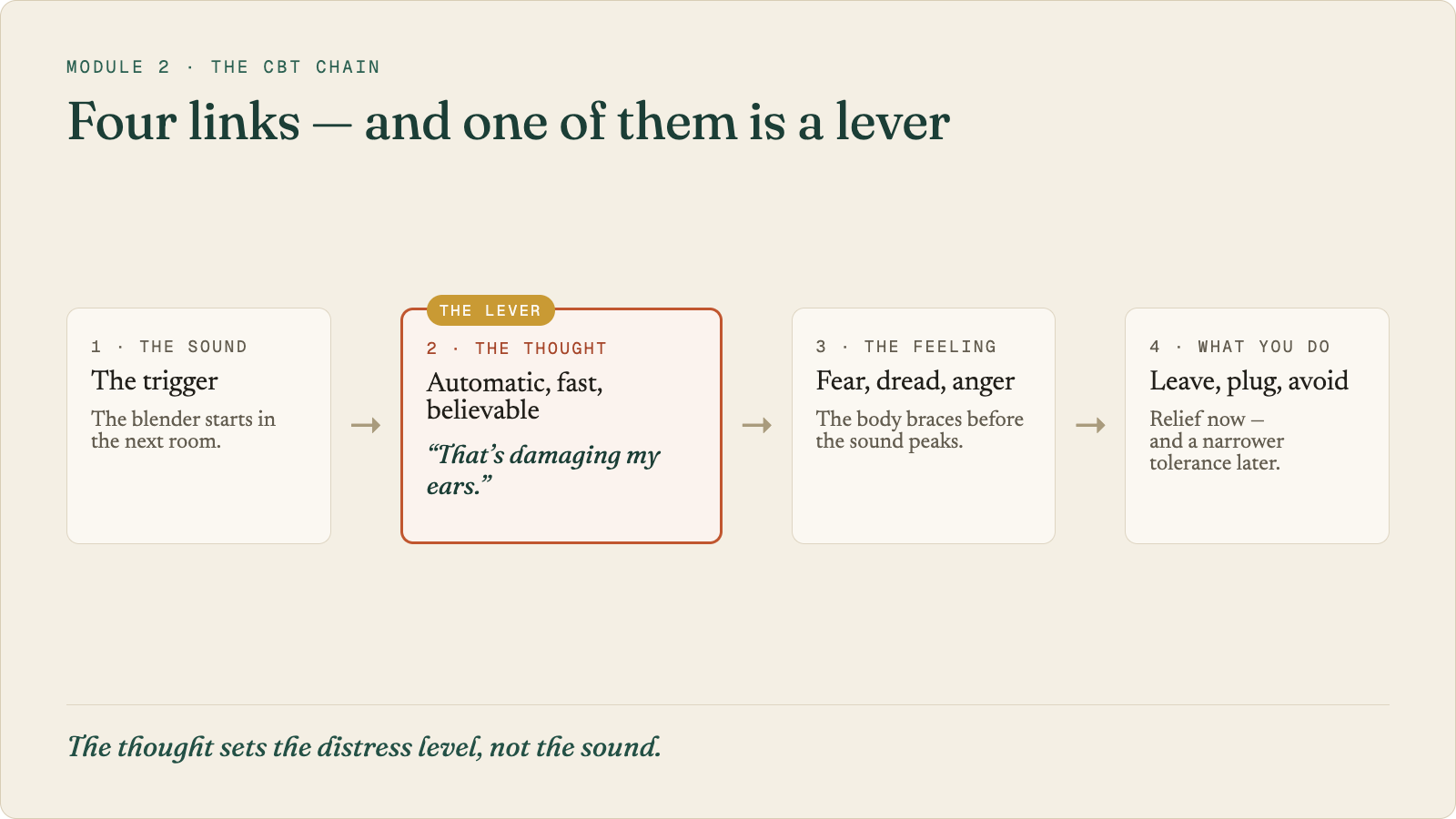
When a sound lands hard, it can feel like the sound went straight to the distress with nothing in between. But there’s always a link in the middle: a fast, almost invisible thought about what the sound means. The chain runs like this:
The sound is the trigger, but it isn’t what sets the level of distress. The thought does, and that’s good news, because the sound is often out of your hands while the thought is exactly where you have the most leverage to change. This is the link the whole program works on, and it’s marked as the lever above for a reason: you can’t always quiet the world, but you can learn to meet it with a truer thought.
Same sound, two thoughts
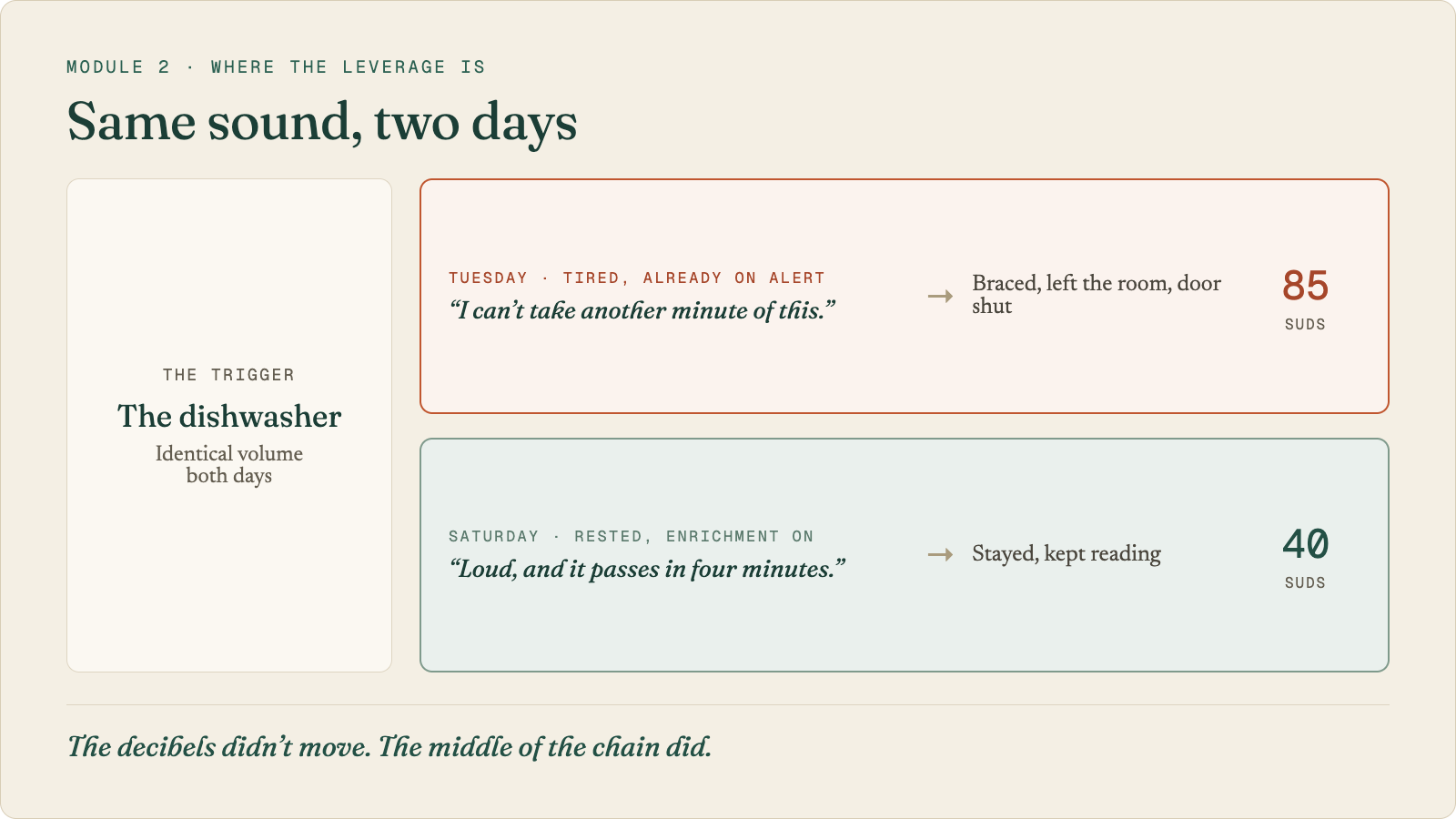
Here’s how much the middle link matters. Picture the same clatter of a dropped pan (identical sound, identical loudness) meeting two different thoughts.
“A sound like that must be damaging my hearing.”
Feeling: fear, a wave of dread Body: heart quickens, shoulders brace What you do: leave, and avoid the kitchen next time“That was loud and unpleasant, but it’s over, and it can’t harm me.”
Feeling: startled, then settling Body: eases within a minute What you do: stay, carry on with the dishesNothing about the sound changed. The thought did, and it carried the feeling, the body, and the behavior with it. We’re not after forced positive thinking here; the accurate thought is simply truer than the alarming one, and Modules 4 and 5 will give you a careful way to find it. This week, the work is just to start noticing the thought is there.
If you’re on the pain pathway, this example needs one adjustment: the pain itself is real, and it’s not what we’re asking you to argue with. The more accurate thought isn’t “it can’t harm me”; it’s closer to “this hurts, and it’s my sensitized nervous system sounding a false alarm, not my ears being damaged.” The catastrophizing worth loosening is the belief that it’s causing permanent harm, never the hurt you’re actually feeling.
Automatic thoughts about sound
The reason the middle link feels invisible is that these thoughts are automatic: fast, practiced, and gone before you catch them. You feel the fear, not the sentence that triggered it. With sound sensitivity they tend to cluster into a few familiar shapes:
- Harm: “that noise is damaging my ears,” “I’ll make my hyperacusis worse.”
- Escape: “I have to get out of here,” “I can’t cope with this.”
- Forecast: “this will ruin my whole day,” “it’s always going to be like this.”
You don’t need to challenge them yet, just to notice them, the way you’d note the weather. Naming the thought is the first move; it turns something that felt like a fact about the world into something you can look at.
Your sound hierarchy
Last module, you started your own ladder of sounds (the real ones you avoid, dread, or brace for, not a hearing-test measurement), starting from what you listed when you signed up. Placed on that ladder is a scale of distress called SUDS: Subjective Units of Distress, a quick 0–100 read on how much something stirs up in the moment. Zero is completely calm; 100 is the most distress you can picture. This is where you and your coach refine it together, adjusting rungs, filling gaps, and agreeing on where the exposure work will start.
It’s worth getting familiar with the scale now, because from Module 5 on, the exposure work climbs this ladder one gentle rung at a time, always starting low, never leaping. Here’s the shape of it. Your personal sounds stay in the hierarchy you and your coach refine together, rather than in an unsaved copy on this page.
Your real hierarchy is the one you started in Module 1 and refine here with your coach; this visual is here only to keep the scale familiar.
A little more enrichment
If last week’s sound enrichment sat comfortably (soft, barely noticed, no added strain), you can add roughly half an hour more across the day. If it felt like too much, or it’s been a hard week, hold exactly where you are. There’s no schedule to keep up with, and more is not better; comfortable and steady is what lets the system settle. Same rules as before: open-ear speakers, kept low enough to almost forget, and never a sound that is itself one of your triggers; if the character of the background has started to bother you, change the sound rather than pushing the time.
This week’s exercise: map five moments
The best way to make the chain real is to catch it in your own week. Over the next few days, when a sound lands hard, walk it back through the four links, and map about five of them here. Seeing five side by side is usually when the pattern in your own thoughts starts to show.
Save a sound-moment map
Complete the saved version in Practice Better so your coach can see the sound, thought, feeling, and response together.
Open Map a Sound Moment (opens in a new tab)Opens Practice Better in a new tab; return to this page after submitting.
Your skills
Two now, and they build on each other.
Skills you’ve learned
2 of a growing setModule 3 adds relaxation and breathing: a way to bring the body’s alarm down directly.
Your daily sound diary
Complete the saved version in Practice Better so your sound moments travel with you and can be reviewed at your check-in.
Open the Daily Sound Diary (opens in a new tab)Opens Practice Better in a new tab; return to this page after submitting.
This week’s practice
The reading shows you the chain; the practice is where you start to catch it in the wild.
Module 2 practice
This week’s homework is set up as a task in Practice Better; you’ll get a reminder and can check it off there.
- Map about five sound moments onto the chain
- When a sound lands hard, catch the thought that came with it
- Keep your daily sound note going
- If last week’s enrichment felt comfortable, add about 30 minutes
Revisit an earlier module
That’s Module 2. You’ve got the chain that runs from a sound to the distress, and the one link in it where the leverage lives. Everything from here builds on that.
Spend the week just noticing the thoughts, without pushing on them yet. That can feel uncomfortable on its own (catching a catastrophic thought with no tool yet to answer it), but that discomfort is expected, not a sign something’s missing: Modules 4 and 5 build the tools for arguing with the thought, and this week is only about learning to spot it clearly first. Give it a few days before moving on; there’s no rush, and your coach paces the program with you.
Save your next steps
Enter your one to three goals in Practice Better, where they are saved and the next weekly check-in can refer back to them.
Open Hyperacusis: My Next Steps (opens in a new tab)Opens Practice Better in a new tab; return to this page after submitting.
Your next module unlocks automatically in Practice Better; you’ll get an email when it’s ready.
Back to all modules