
Module 4 · for hyperacusis
Working with the thoughts
In Module 2 you learned to catch the thought that sits between a sound and the distress. This module gives you what to do with it: a simple, careful way to check whether the alarming thought is actually true, and to answer it with one that fits the facts better. Not cheerier. Truer.
First, how did the week go?
A couple of minutes looking back before the new material. Start with what worked; it’s the easiest part to overlook and the most worth building on.
Your weekly check-in
Complete your check-in in Practice Better, where your responses are saved and reviewed by your coach.
Open Hyperacusis Weekly Check-In (opens in a new tab)Opens Practice Better in a new tab; return to this page after submitting.
Already completed it? Continue to this week’s material below.
A thought is a guess, not a fact
When a sound sets off the thought “that’s damaging my ears,” it doesn’t arrive feeling like an opinion. It arrives feeling like a fact: urgent, certain, already true. But an automatic thought is really a fast guess your alarm system makes under pressure, and alarm systems are built to overestimate danger. That’s their job. It’s far better for an alarm to cry wolf than to miss a real threat, which means many of these thoughts are louder than the evidence behind them.
So instead of believing the thought or trying to force it away, you learn to do something a scientist would recognize: treat it as a claim, and look at the evidence, on both sides. Sometimes the thought holds up. More often it turns out to be the alarm talking, and a truer, calmer thought was available all along. The tool for this is the thought record.
The traps sound sensitivity sets
Under stress, thoughts tend to fall into a few recognizable shapes, well-worn grooves that feel true precisely because they’re so familiar. With sound sensitivity, five show up again and again. Just being able to name one as it happens takes some of its power.
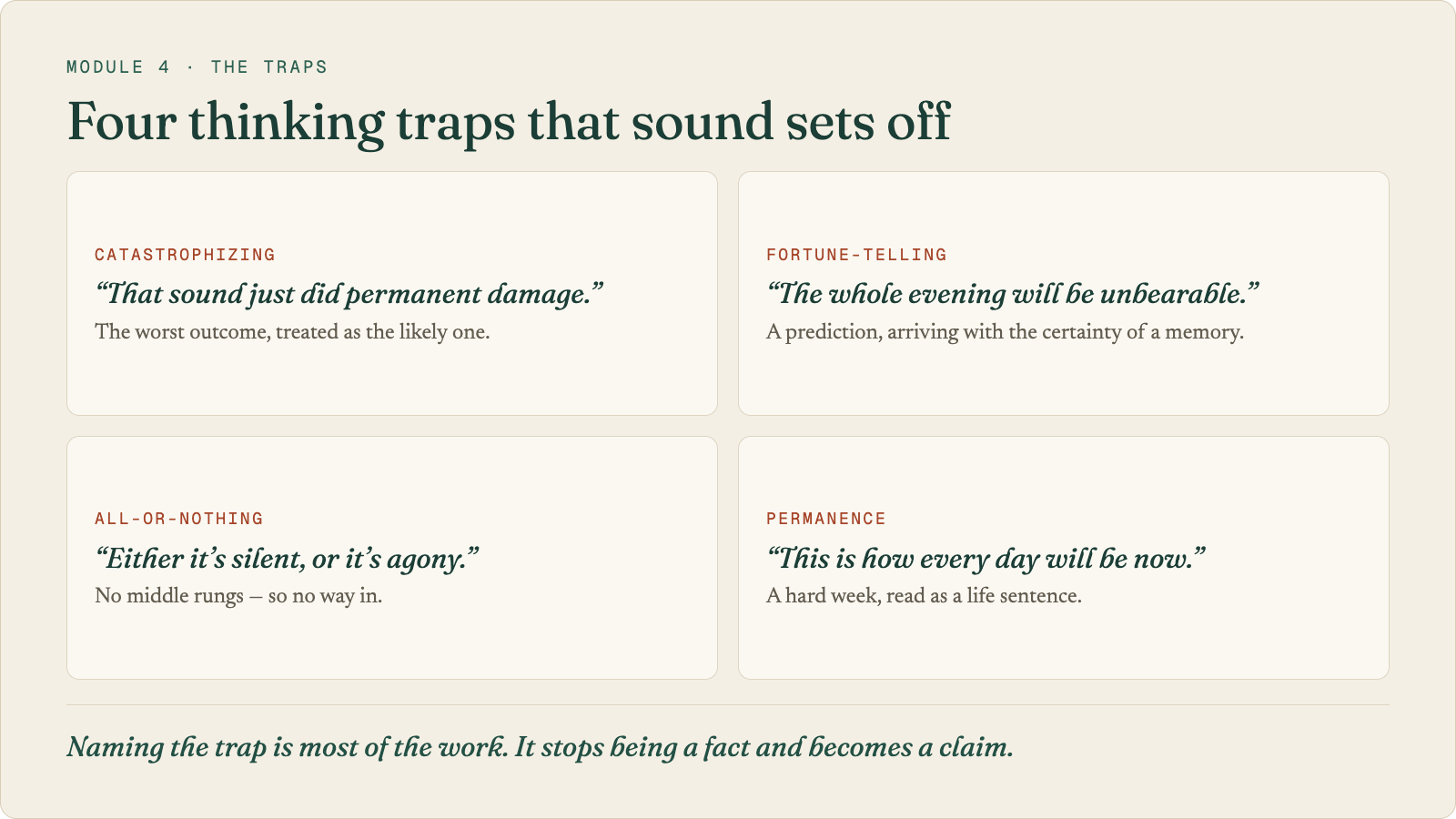
One important exception. If sounds cause you genuine physical pain, your caution is not a thinking trap; pain is real information, and none of this work is about overriding it or pushing through. What the thought record can still ease is the catastrophic forecast that often rides along with the pain (“this means permanent damage,” “my life is over”), which is a separate thing from the pain itself. If you’re on the pain-dominant profile, your coach will reflect how the program’s pain-profile rules apply.
The thought record
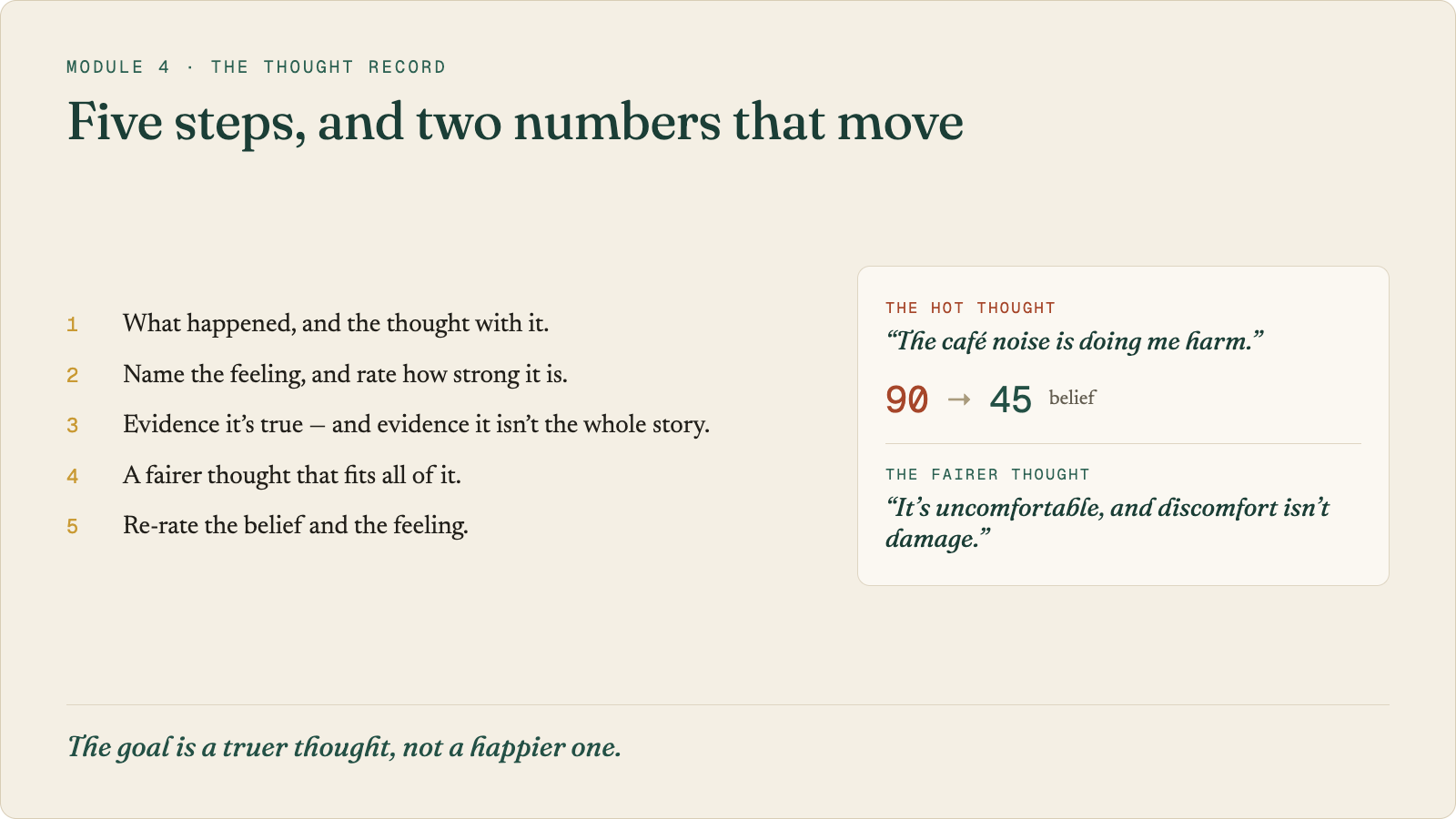
A thought record walks a hot thought through a few plain questions. The goal isn’t to argue yourself happy, or to chase reassurance; it’s to end up with a thought that’s truer: one that fits all the evidence, not just the frightening part. Here’s one worked through, so you can see the shape (one illustrative example, not an average or expected result; your own numbers may shift more, less, or not at all on any given try):
-
The momentA neighbor started drilling through the wall.
Automatic thought“That’s damaging my hearing; I’ll be worse for weeks.”
Evidence it’s trueIt was loud and unpleasant, and my ears felt full afterward.
Not the whole storyThis kind of everyday household sound is very unlikely to be at injury levels; my clinician explained the sound isn’t harming me; the fullness has always settled before, and I’ve recovered from loud days many times.
A fairer thought“That was loud and I hated it, but it’s very unlikely to have harmed me, and the discomfort will pass like it always has.”
Belief85%→35% Distress80→45
Notice the fairer thought doesn’t pretend the sound was pleasant. It just refuses to let the alarm write the whole story, and as the belief in the frightening thought drops, the distress eases with it. Now try one of your own.
Save your thought record
Complete the saved thought record in Practice Better, where you and your coach can review how the belief and distress shifted.
Open Hyperacusis Thought Record (opens in a new tab)Opens Practice Better in a new tab; return to this page after submitting.
Your skills
A fourth to keep: the partner to catching the thought.
Skills you’ve learned
4 of a growing setModule 5 begins the gentle, gradual work of meeting sound, a step at a time, with everything you’ve built so far to hold you steady. Often the most convincing evidence against an alarming thought isn’t an argument; it’s an experience. That’s what the exposure work adds next.
Your daily sound diary
Complete the saved version in Practice Better so your sound moments travel with you and can be reviewed at your check-in.
Open the Daily Sound Diary (opens in a new tab)Opens Practice Better in a new tab; return to this page after submitting.
This week’s practice
Thought records get easier, and more convincing, the more you do them. Two this week is a good aim. If the full list below feels like a lot, the thought records and daily notes matter most this week; the body skills and enrichment are habits by now, not new tasks.
Module 4 practice
This week’s homework is set up as a task in Practice Better; you’ll get a reminder and can check it off there.
- Complete two thought records
- Keep catching automatic thoughts as they happen
- Keep up the body skills and your enrichment
- Keep your daily sound note going
That’s Module 4. You now have the full pair: catching the thought, and answering it. Together they’re how you take the frightening story a sound tells and hold it up to the light, and most of the time, it turns out truer and calmer than the alarm claimed.
Give it a week of real practice before moving on. This is a skill, and the fluency comes from repetition; there’s no rush, and your coach paces the program with you.
Save your next steps
Enter your one to three goals in Practice Better, where they are saved and the next weekly check-in can refer back to them.
Open Hyperacusis: My Next Steps (opens in a new tab)Opens Practice Better in a new tab; return to this page after submitting.
Your next module unlocks automatically in Practice Better; you’ll get an email when it’s ready.
Back to all modules