
Module 3 · for hyperacusis
Settling the body
So far you’ve worked with what you think about sound. This module works with what your body does around it (the bracing, the clenched jaw, the wired, on-alert feeling), because that arousal is part of what keeps sound sensitivity going, and it’s something you can turn down directly.
First, how did the week go?
A couple of minutes looking back before the new material. Start with what worked; it’s the easiest part to overlook and the most worth building on.
Your weekly check-in
Complete your check-in in Practice Better, where your responses are saved and reviewed by your coach.
Open Hyperacusis Weekly Check-In (opens in a new tab)Opens Practice Better in a new tab; return to this page after submitting.
Already completed it? Continue to this week’s material below.
The body’s part in the loop
Remember the cycle from Module 1: avoidance gradually turns the system’s gain up. There’s a partner to that in your body. When sound feels threatening, your nervous system shifts into a braced, on-alert state: shoulders up, jaw tight, breath shallow, senses turned outward and scanning. And a braced body is a body primed to hear the next sound as bigger. Arousal and sound sensitivity feed each other.
That’s frustrating, but it’s also an opening: the body is something you can act on directly. You can’t decide to feel calm, but you can release a clenched jaw and slow a breath, and the calmer body sends the nervous system a steady signal that there’s no emergency here. Two tools do most of this work: releasing held tension, and slowing the breath.
A braced body hears threat. A settled body hears sound. You can’t argue your way calm, but you can loosen your way there.
Releasing the tension you’re holding
Much of the bracing that comes with sound sensitivity settles in a few predictable places (the jaw, the neck, the shoulders), and it becomes so constant you stop noticing it. Progressive muscle relaxation works by tensing each area gently and then letting go, which does two things: it teaches your body the felt difference between holding and releasing, and it leaves the muscle looser than before. We’ll spend extra time where sound sensitivity lives.
Aim to do it once a day, ideally around the same time; the regularity itself becomes a cue your body learns to relax to. Start at whatever feels easy, perhaps ten minutes, and let it grow toward fifteen as it becomes familiar. Move at your own pace; there’s no clock here. This full version is the starting point, not the destination: over the coming weeks, as the settled state becomes familiar, you’ll learn to reach the same release in just a few seconds, without needing to move through every step.
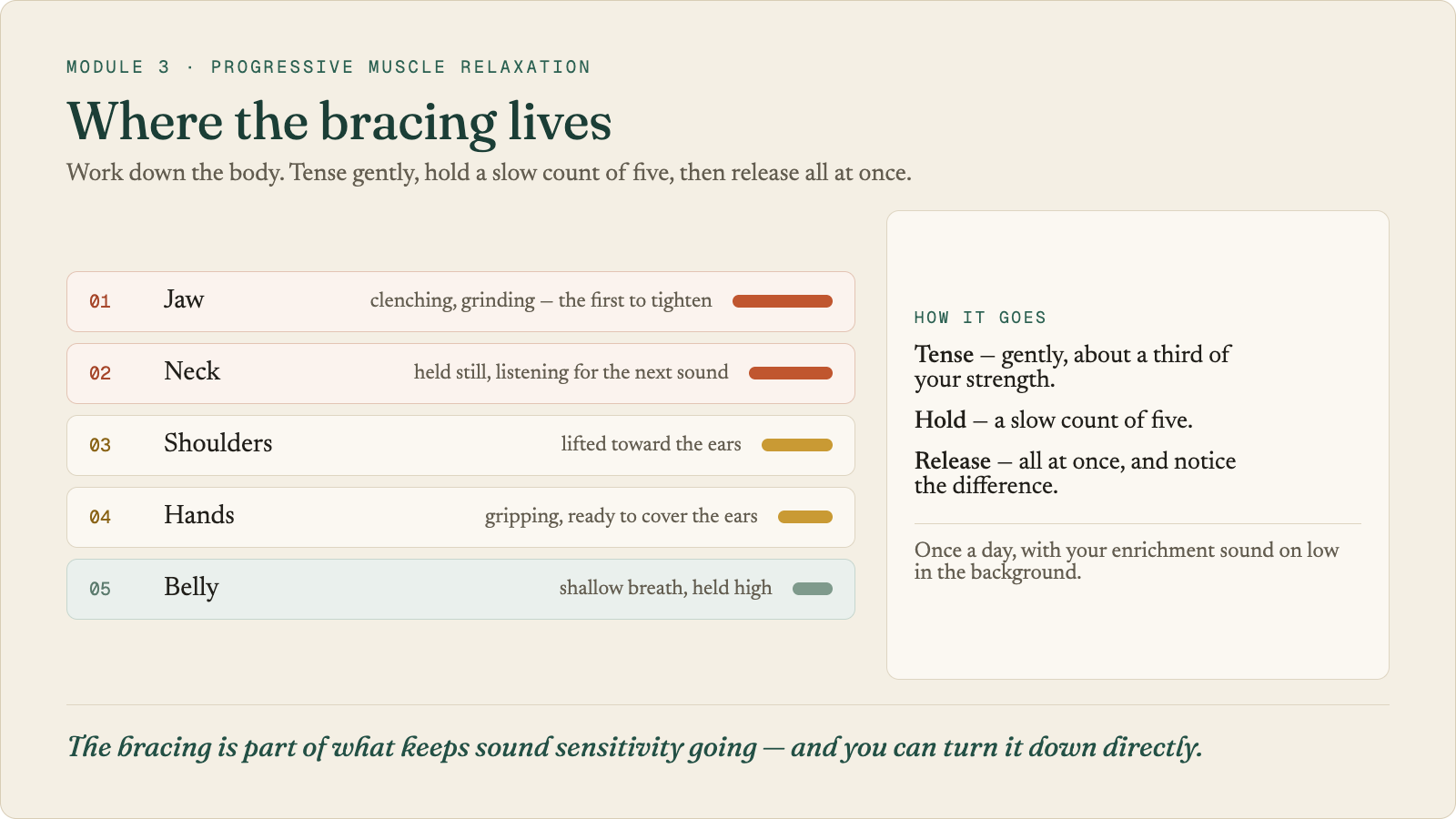
Progressive muscle relaxation
Self-paced · move at your own speedThe tense-and-release is deliberately gentle: never tense to the point of strain, especially the neck and jaw. If any area is injured or painful, simply skip it and rest there instead.
If you’re on the pain pathway, the tensing step itself can feel like too much; a heightened sensitivity to bodily sensation is common, and you don’t have to push through it. Skip the tense-and-release and move through the same steps as a body scan instead: rest your attention on each area in turn, notice whatever is already there, and let it be however it is, without adding tension first.
Jaw or neck tension that lingers well beyond your practice, or a jaw that clicks, locks, or aches on its own, is worth mentioning to your clinician. Sound sensitivity and jaw or neck symptoms can influence each other, and it’s useful information either way, not a sign that something’s gone wrong.
Slowing the breath
Breath is the fastest way into the body’s alarm, which makes it your rapid-deployment tool: the one you can reach for the instant a sound catches you off guard, anywhere, with no setup. The aim is diaphragmatic breathing: rest a hand on your belly and let it be the part that rises, not your chest. The rule: slow and low, not big. This isn’t about big, deep lungfuls; large breaths can tip you into light-headedness and more arousal, not less. Small, slow, and a longer breath out than in. As a concrete anchor: aim for roughly five breaths a minute, about what the pacer below is set to, or simply whatever feels slow and comfortable if counting gets in the way. There’s no exact number to hit; slower and steadier than your usual breathing is what matters.
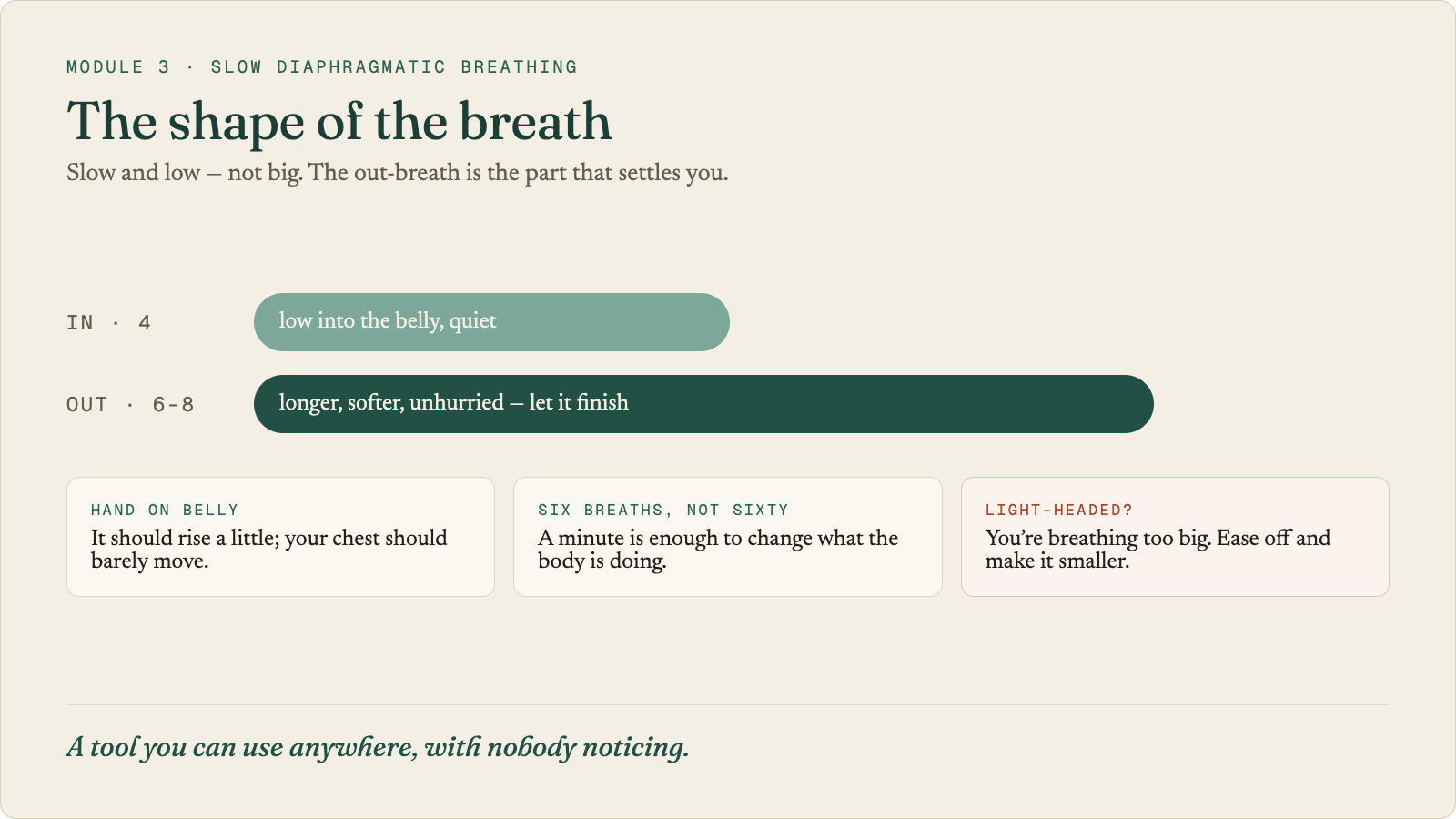
The breathing pacer
Optional · a visual guideSlow and low, not big
Let the circle lead: breathe in as it grows, out as it shrinks. If a moving circle feels uncomfortable, just follow the words; the timing is the same. If you ever feel light-headed, you’re breathing too big; ease off and let it be gentler.
Pairing calm with sound
Here’s a small move with a lasting effect. Try one of your relaxation practices (the PMR, or a few minutes with the pacer) with your sound enrichment on, low in the background. Over time your nervous system starts to file gentle sound alongside calm rather than threat. It’s the opposite of the bracing loop: instead of sound arriving with alarm, it arrives with settling.
Enrichment, to practice with
Optional · starts only when you tapKept low, on open-ear speakers: below your calm, not over it. Turn it on, then start a round of breathing or PMR.
Other things patients say help
Alongside PMR and breathing, some patients find that cardio exercise (done somewhere quiet, like a carpeted room or a soft-floored gym, to keep impact noise low) and a hot bath take the edge off the mood and anxiety side of sound sensitivity more than sitting still does. There’s no hyperacusis-specific research behind either one yet, so think of them as optional add-ons other patients have found worth trying, not a replacement for the tools above.
Save your relaxation plan
Set your practice times and supports in Practice Better so the plan is saved for the week ahead.
Open Relaxation Practice Plan (opens in a new tab)Opens Practice Better in a new tab; return to this page after submitting.
Your daily sound diary
Complete the saved version in Practice Better so your sound moments travel with you and can be reviewed at your check-in.
Open the Daily Sound Diary (opens in a new tab)Opens Practice Better in a new tab; return to this page after submitting.
Your skills
A third to keep: this one lives in the body.
Skills you’ve learned
3 of a growing setModule 4 turns to the thoughts themselves: a careful way to answer the alarming ones with something truer.
This week’s practice
These are skills, and skills grow with repetition: a little each day beats a lot once.
Module 3 practice
This week’s homework is set up as a task in Practice Better; you’ll get a reminder and can check it off there.
- Do the muscle relaxation once a day
- When a sound catches you off guard, reach for the breath
- Try one relaxation practice with your enrichment sound on low
- Keep your daily sound note going
That’s Module 3. You now have a way to work with the body’s side of sound sensitivity, to loosen the bracing and slow the breath, and a way to pair calm with the very thing that used to bring alarm.
Give these a week to become familiar before moving on; the body learns them by repetition, not by reading. There’s no rush, and your coach paces the program with you.
Save your next steps
Enter your one to three goals in Practice Better, where they are saved and the next weekly check-in can refer back to them.
Open Hyperacusis: My Next Steps (opens in a new tab)Opens Practice Better in a new tab; return to this page after submitting.
Your next module unlocks automatically in Practice Better; you’ll get an email when it’s ready.
Back to all modules