
Module 1 · for hyperacusis
Understanding hyperacusis
This first module is mostly about understanding, because once you see what makes ordinary sound feel unbearable, it stops being a threat with no explanation and becomes something with working parts you can change. You’ll also set up your first tool and start a daily sound note.
Why sound feels too loud
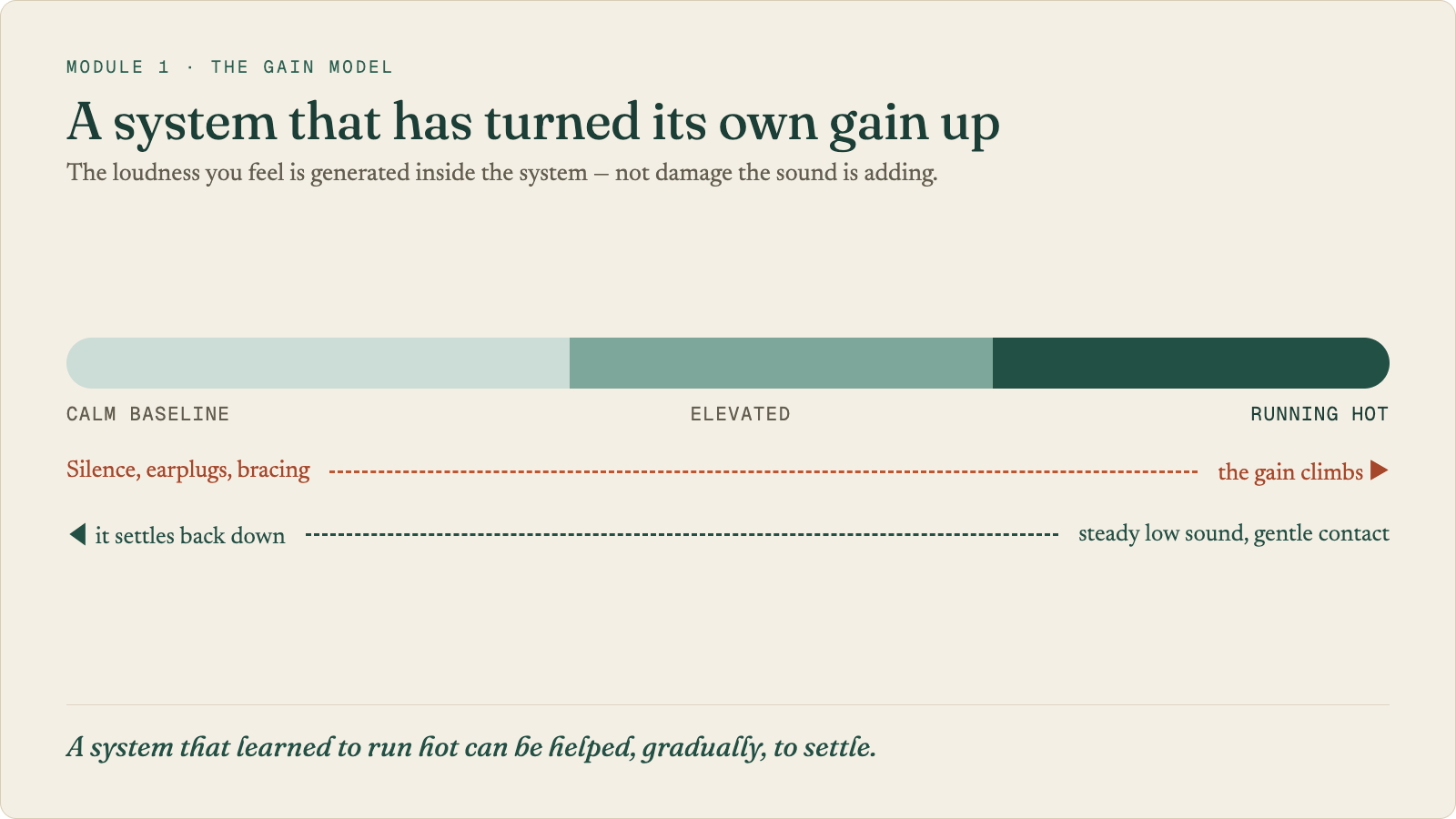
Hyperacusis is a reduced tolerance to everyday sound: sounds most people barely notice can feel painfully loud, sharp, or intrusive. For most people this reflects a change in how the auditory system is amplifying sound, not damage that ongoing noise is adding to. The system has turned up its own gain, the way a hearing aid or a microphone can be set too high, so signals that should arrive gently arrive turned all the way up. That’s the model clinicians use to explain it (the details of how vary from person to person, and research is still filling them in), but it’s a useful enough picture to work from.
That matters, because it means the everyday sound around you isn’t harming your ears each time you hear it. The loudness you feel is real (it is being generated inside a system that has learned to run hot), and a system that has learned to run hot can be helped, gradually, to settle back down.
One distinction worth knowing from day one, before any exercises start: this program is for a rise in ordinary sound sensitivity. Sudden or one-sided hearing loss, new one-sided or non-stop ringing, ear fullness with an actual change in your hearing, or dizziness are not part of that picture. Sudden hearing loss especially is time-sensitive: don’t wait for a scheduled check-in; contact your clinician or seek prompt medical care.
Stress can turn that same gain up, on its own; it’s not just about sound. A nervous system already under strain runs hotter across the board, sound included. That’s part of why your intake asks about mood and anxiety too: not because sound sensitivity is "in your head," but because a stressed system and a sound-sensitive one feed the same alarm. The order matters: the alarm comes first, and the worry follows. A system that has tagged sound as a threat produces anxiety, and the anxiety then keeps the alarm fed, which is why both get attention here without either being blamed for the other.
If a clinician has ever told you this was just anxiety and left it there, you’re not alone; it’s a common experience, and an understandable dead end when the underlying mechanism isn’t part of the conversation. This program starts from that mechanism instead: what’s written here is grounded in the published research on how the auditory system’s gain changes (see the evidence page), not a guess about your state of mind.
One more part of the picture, because it explains a lot of what happens next. The auditory system doesn’t only react to sound; it predicts it. When the system expects a sound to do harm, it behaves as though harm is arriving: it braces early, turns the gain up, and reads whatever the ear feels afterward as confirmation. That expectation is a gain-raiser in its own right, separate from how anxious you feel in the moment, and it runs below the level of choosing. This isn’t a statement that your beliefs caused this, and it doesn’t make careful judgment about your real limits a mistake. It’s the reason the program spends time on what the system expects, not just on what it hears.
Information feeds that prediction too. People with sound sensitivity read a great deal, and some of what circulates (“one restaurant made me permanently worse,” “if it hurts, you’ve added damage”) lands on a system that is already guarding. You don’t need to distrust other people’s experiences; it’s enough to notice when a piece of information has quietly become part of your own alarm, so that Module 4 can look at it alongside the other automatic thoughts.
For most people, the distress isn’t the sound itself. It’s the alarm the nervous system has attached to it: the gain it has turned up, and gain that goes up can come back down. If sound causes you physical pain, part of your picture is different, and this page comes back to that below.
The cycle that keeps it going
There’s a loop that gradually tightens over time. It’s the most important thing to understand this week, because everything the program does is aimed at loosening it.
The cycle
The cycle
The loop tightens.
Trigger
A sound feels too loud.
Response
You expect harm, and avoid or brace.
Mechanism
The gain turns up.
Result
Tolerance narrows.
-
Trigger
A sound feels too loud.
-
Response
You expect harm, and avoid or brace.
-
Mechanism
The gain turns up.
-
Result
Tolerance narrows.
-
The cycle
The loop tightens.
A sound feels too loud, the system expects harm, so you avoid it or brace, and each corner feeds the next, tightening the loop. The work ahead helps that expectation update when the situation is actually safe.
It runs like this: a sound feels too loud, the system predicts the next one will hurt, so you avoid it or tense against it (understandable, it’s uncomfortable). But when the system gets less ordinary sound, it compensates by turning its gain up further, and your tolerance narrows. So the next time, a slightly quieter sound feels too loud too, and the avoiding grows. This is why protecting yourself from all sound, though it feels like the safe thing, is the very thing that makes the world louder.
One clarification, so this doesn’t get overcorrected: earplugs still belong at concerts, construction sites, and other genuinely loud events; that’s ordinary hearing protection, not avoidance. What we’re working on here is the habit of reaching for them in everyday, ordinary-volume life.
The good news is the same loop runs in reverse. Gentle, gradual contact with sound, at a level you can manage, lets the system turn its gain back down, and tolerance widens again. That’s the whole arc of this program. You won’t start that work this week; you’ll start by understanding it, and by giving the system a soft, steady baseline to settle against.
The kinds of sound sensitivity
“Hyperacusis” covers a few different experiences, and people often have more than one. Naming yours helps, and it’s part of what your coach uses to apply the program’s rules to you. None of these is a verdict; they’re just descriptions.
If sounds cause you physical pain (especially a sharp pain, or one that lasts after the sound is gone), please make sure your coach knows, in your daily note and at your check-in. It doesn’t mean anything has gone wrong; it means we take a gentler, slower path built for it, rather than the standard one.
Two close neighbors sometimes travel with hyperacusis: misophonia (strong reactions to specific trigger sounds, often ones other people make) and phonophobia (fear of sound itself). If those fit you better, tell your coach; the program adapts.
Why your ears can feel physically different afterward
Many people notice that after a hard sound, or a loud day, the ear itself feels changed: a sense of fullness or blockage, popping, a fluttering or thumping feeling, hearing that seems muffled or slightly distorted for a while, a dull ache, or sharper sensations (stabbing, burning, tingling, numbness) in or around the ear that can spread toward the cheek, jaw, or side of the neck. Sometimes it arrives hours later, or builds across a day rather than at the moment of the sound. If any of that is familiar, it deserves an explanation, because without one it reads as injury.
One clinical model explains this cluster as a protective muscle response, not damage. Two small muscles sit in the middle ear. One of them tightens the eardrum and stiffens the tiny bones behind it, and it can be set off not only by loud sound but by the anticipation of sound, by startle, and by tension in the jaw. When the system has tagged sound as unsafe, that muscle can tense sooner, harder, and for longer than it needs to. A muscle held that way can pull on the eardrum (fullness, muffling, flutter), change how the ear ventilates (popping), and irritate a nearby nerve (the aching, burning, or stabbing quality). Clinicians who work this way report the cluster in most people with severe hyperacusis, and in many with tinnitus. It is one proposed mechanism, not a settled one, and this program doesn’t diagnose it. What it offers is a plausible, non-damaging account of sensations that otherwise feel like proof that something broke.
The sensations are real; what changes is what they mean. On this model they say “the system braced,” not “the inner ear was harmed,” and that is exactly the kind of interpretation Module 4 will teach you to check. It also explains why a bad day can leave the ears feeling worse without anything having been added to the underlying picture.
This does not replace the rule at the top of this page. Ear fullness with an actual change in your hearing, sudden or one-sided hearing loss, new one-sided ringing, or dizziness still mean contacting your clinician promptly, and new or worsening ear pain is always worth a medical look. The model above is for sensations your clinician has already checked and cleared. Once that’s done, the most useful thing you can do with them is notice briefly and move on: checking and re-checking an ear that has been braced tells the system the guard is still needed, which is the surveillance Modules 3 and 9 will help you set down.
Your first tool: sound enrichment
Silence is where hyperacusis is at its worst. In a quiet room the system, hunting for input, turns its gain up even further, so the next sound lands harder. Sound enrichment gives it a low, steady, neutral background to rest against. The model, drawn from face-to-face hyperacusis care and extrapolated here rather than separately demonstrated in a self-guided format, is that this stops the gain from climbing and starts, gently, to bring it down.
The aim is a soft, broadband background (a fan, a nature-sound track, or the sample below), kept quiet, well below the point where it competes for your attention. A few pointers that make the difference:
- Open-ear speakers in the room, never headphones or earbuds. The sound should surround you softly, not sit against your eardrum.
- A couple of hours a day, spread out: roughly two to four, in whatever stretches fit your life. It doesn’t need to be constant.
- Barely there. If you find yourself listening to it, it’s too loud. Turn it down until it’s almost forgettable.
- Never one of your own trigger sounds. Enrichment is a neutral background, not practice. If a particular character of sound sets you off (for many people that includes digital or electronic sound, or anything close to the ear even at low volume), it doesn’t belong here; it belongs on the ladder, later, as exposure. That’s one more reason for a room speaker and a plain, natural sound.
If sound causes you physical pain, enrichment is optional rather than expected. Start later and lower than the pointers above, keep it short at first, and if the physical cluster described earlier on this page shows up during or after it, stop and note it for your check-in. For some people with pain-type sensitivity, even soft background sound is more than the system wants yet, and that is information, not a failure.
Most of the research behind sound enrichment tested small, ear-worn sound generators (worn like a hearing aid, all day) rather than a speaker across the room. Room speakers are a gentler, more accessible way to apply the same underlying principle, but they haven’t been studied head-to-head against ear-worn devices. If ear-level enrichment is available to you and your audiologist or clinician thinks it’s a good fit, it’s worth asking about, but the open-ear-speaker approach here is a reasonable, evidence-informed adaptation, not a downgrade.
A soft sound to try
Optional · starts only when you tapNothing plays until you tap. On open-ear speakers, kept low: below the sound around you, not over it.
Your skills
Each module adds one skill to keep. Here’s the first.
Skills you’ve learned
1 of a growing setModule 2 adds the CBT map for sound sensitivity: how a thought about a sound shapes how loud it feels.
Your daily sound note
Once a day, jot down one sound moment, not to grade the loudness, but to see the pattern. Over a week or two, the notes show what turns the volume up, what you tend to avoid, and where pain (if you have it) shows up. Use the saved notes below so the pattern is available to you and your coach at the next check-in.
Your daily sound diary
Complete the saved version in Practice Better so your sound moments travel with you and can be reviewed at your check-in.
Open the Daily Sound Diary (opens in a new tab)Opens Practice Better in a new tab; return to this page after submitting.
Start building your hierarchy
From Module 5 on, the exposure work climbs a personal ladder of sounds, not a hearing-test measurement, but the real-life sounds you actually avoid, dread, or brace for. When you signed up, you listed the sounds you avoid, dread, or brace for; that list is the start of the ladder. This week, take it further: add anything it’s missing, and give each sound a distress rating from 0–100 (SUDS): how much it stirs up in the moment, not how loud it actually is.
You don’t need to get this exactly right. You and your coach refine it together in Module 2, before any exposure work begins.
Save your sound hierarchy
List the sounds, situations, or places you avoid or brace for, rate each 0–100, and save it in Practice Better at the end of the module. Your coach reviews it and helps confirm the most manageable starting point before any exposure begins.
Open My Sound Hierarchy (opens in a new tab)Opens Practice Better in a new tab; return to this page after submitting.
This week’s practice
The reading matters, but the change begins here: in the small things you do between now and Module 2.
Module 1 practice
This week’s homework is set up as a task in Practice Better; you’ll get a reminder and can check it off there.
- Set up sound enrichment where the quiet is hardest
- Add a daily sound note, if it’s useful
- Start your sound hierarchy: list your avoided sounds and rate each 0–100
- Notice one sound that bothered you less than expected
That’s Module 1. You’ve got the picture of how hyperacusis works, the cycle that keeps it going, your first tool in place, and a daily note started; that’s the foundation everything else builds on.
Give the enrichment a few days to settle in before moving on. There’s no rush, and no falling behind; the modules wait for you, and your coach paces the program with you.
How the weeks work
This is a Guided program: you work through each module at your own pace, and once a week your coach reads your check-in and writes back: a short note to keep you on track and decide, together, when to move on. There’s no separate testing or in-person appointment to arrange; everything lives here. In particular, Kodama deliberately doesn’t use loudness-discomfort testing (the kind where sounds are turned up until they hurt). Some clinicians advise against it for hyperacusis because it can aggravate the very sensitivity it measures, and the program works from your real-life ladder instead.
Save your next steps
Enter your one to three goals in Practice Better, where they are saved and the next weekly check-in can refer back to them.
Open Hyperacusis: My Next Steps (opens in a new tab)Opens Practice Better in a new tab; return to this page after submitting.
Your next module unlocks automatically in Practice Better; you’ll get an email when it’s ready.
Back to all modules